

Managed Office vs Coworking vs Traditional Lease Guide

Short answer
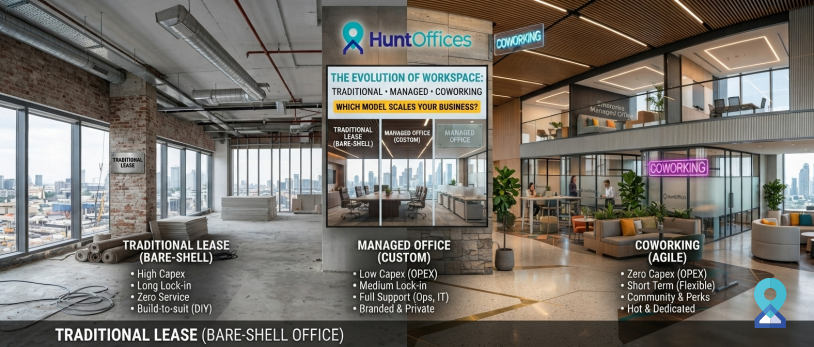
Pick coworking for small or fast-changing teams, a managed office for mid-sized teams that want a private, branded space without the build-out, and a traditional lease for large teams with a stable headcount and capital to invest.
One provider's cost guide puts the split at under 30 people for coworking, 40 to 100 for a managed office, and large stable teams for a traditional lease (myHQ). Treat these as rules of thumb, not hard lines. Your growth plans, budget and need for privacy matter more than the headcount alone.
Serviced office and managed office are often used loosely. This guide explains the difference and compares all three options side by side.
What each option means
• Coworking space. A shared workspace where teams, freelancers and companies work under one roof. You rent desks, cabins or meeting rooms, usually on short plans.
• Serviced office. A furnished private office run by an operator, with internet, reception and housekeeping included. Your team has its own lockable room inside a larger building.
• Managed office. A private office set up for your team, often with your layout, branding and furniture. The operator builds and runs it, and you pay a monthly fee instead of investing in fit-out. WeWork India describes it as a space used only by your team, which can be aligned with your brand (WeWork India).
• Traditional lease. You rent the premises from a landlord, usually for several years, and arrange the fit-out, furniture, utilities and upkeep yourself.
Providers use "serviced office" and "managed office" in slightly different ways. Ask each one exactly what is included, how much you can customise, and how long you must commit.
Managed office vs coworking vs traditional lease: side by side
| Coworking | Serviced office | Managed office | Traditional lease | |
| Space | Shared floor, desks and cabins | Private furnished office | Private office built for your team | Whole premises you rent |
| Privacy | Low to medium | High | High | Highest |
| Branding | Limited | Limited | Strong, aligned to your brand | Full control |
| Customisation | Very little | Little | Layout, furniture and finishes | Full, at your cost |
| Typical commitment | Monthly or short plans | Short to medium, varies by provider | 1 to 2 years | Several years |
| Upfront cost | Small deposit | Deposit | Deposit, little or no fit-out | Deposit, fit-out, furniture, brokerage |
| Scalability | Easy to add or drop seats | Moderate | Moderate, set by the contract | Hard, you carry unused space |
| Who runs it | Operator | Operator | Operator | You |
| Best for | Small or changing teams | Teams wanting a private room, fast | Mid-sized teams wanting privacy without a build-out | Large, stable teams with capital |
Commitment details here follow the ranges in provider guides. For example, one Bangalore comparison lists coworking with about 30 days' notice to change seats, managed offices at 12 to 24 months, and traditional leases at 5 to 9 years (myHQ). Your own contract may differ, so always read the terms.
Which option fits your team size
| Team size | Usually fits | Why | Watch out for |
| 1 to 10 | Coworking, or a small serviced office | Low cost, short commitment, no setup | Little privacy and branding |
| 10 to 30 | Coworking cabins or a serviced office | Room to add seats, some privacy | Per-seat cost rises as you grow |
| 30 to 100 | Managed office | Private, branded, no build-out | Longer commitment, exit terms |
| 100 and above, stable headcount | Managed office or traditional lease | Control and lower cost per seat over time | Capital, fit-out and long lock-in for a lease |
These bands are rules of thumb. A provider guide suggests coworking under 30 people, a managed office for 40 to 100, and a traditional lease for large teams with a stable five-year headcount and capital to spend (myHQ). That guide is written by a managed office provider, so check the numbers against your own quotes.
A team of 25 that expects to double in a year may do better in coworking cabins than in a 2-year managed office. A team of 60 with a fixed plan and client visits may do better in a managed office than in a shared floor. Size is a starting point, not the answer.
What each option really costs
The monthly price is only part of the cost. This table uses one provider's Bangalore example for an 80-seat team. It is illustrative, comes from a managed office provider, and will differ by city, building and year (myHQ).
| Coworking | Managed office | Traditional lease | |
| Monthly price | ₹9,000 to ₹18,000 per seat | ₹5,000 to ₹8,000 per seat | ₹90 to ₹120 per sq ft, plus operating costs |
| Deposit | 1 to 2 months' fees | 1 to 2 months' fees | 3 to 6 months' rent |
| Fit-out | None | Little or none | ₹1,200 to ₹1,800 per sq ft, one time |
| Utilities, housekeeping, upkeep | Included | Included | Paid by you |
| Brokerage | Usually none | Usually none | 1 to 2 months' rent |
A traditional lease has more cost lines than the rent: fit-out, furniture, electricity, maintenance contracts for AC and power backup, housekeeping, security and yearly rent increases. The same guide quotes increases of 5 to 8% a year.
Compare quotes on the same basis. Ask each provider for the total monthly cost, including GST and every add-on, for the same number of seats and the same term. Fees for coworking and managed offices usually attract 18% GST, and you can often claim it back as credit. See our guide on GST input credit on coworking rent.
Control, branding and privacy
This is where the three options differ most.
• Privacy. In coworking, people from other companies work nearby. A serviced or managed office gives your team its own lockable space. This matters if you handle client data, hold calls all day or host visitors.
• Branding. A shared floor leaves little room for your brand. A managed office can carry your colours, signage and layout, so clients see your company, not the operator's. A traditional lease gives full control.
• Customisation. Coworking uses the existing setup. A managed office lets you choose layout, furniture and finishes within the operator's limits. With a lease, you decide everything and pay for it.
• Operations. In coworking, serviced and managed offices, the operator handles housekeeping, internet, power backup and repairs. In a lease, you hire or contract for all of it.
• Compliance. Check whether you can use the address for company or GST registration, and whether the operator allows your staff access at all hours.
If privacy and brand matter more than flexibility, look at a managed or serviced office first. If speed and low commitment matter more, start with coworking.
Scalability, commitment and exit
The risk to price in is not the rent. It is what happens if your headcount changes.
• Coworking. You can usually add or drop seats on short notice. Check the lock-in period and notice period in your agreement, because plans differ.
• Serviced office. Terms are short to medium, but the room has a fixed size. If you outgrow it, you move.
• Managed office. A longer commitment, often one to two years, and the space is sized for your team. Ask whether you can add seats, hand back seats or move to a larger floor mid-term.
• Traditional lease. The longest commitment. If you shrink, you still pay for the space unless the lease has a break clause or you can sublet.
For each option, read the exit terms before the price: lock-in, notice, deposit refund and what you owe if you leave early. Our guide on coworking space agreements in India covers these clauses.
Many teams mix options. A managed office for the core team, plus coworking seats or meeting rooms for overflow and new hires, keeps the base cost fixed while leaving room to grow.
Which one to choose: common situations
| Your situation | Best starting point |
| Early-stage startup, team of 5, plans change monthly | Coworking |
| Freelancer or remote team that meets a few days a week | Coworking, or a hot desk |
| Team of 15 that wants a private room for client calls | Serviced office or coworking cabin |
| Team of 40 to 80, fixed plan for 2 years, brand matters | Managed office |
| Company opening a branch office in a new city | Managed or serviced office, to avoid a build-out |
| Team of 150 or more, stable for 5 years, capital available | Traditional lease, or a large managed office |
| Fast-growing team with unclear headcount | Coworking now, with a plan to move to a managed office |
If you fall between two rows, ask for quotes on both and compare the total cost for the same term. Then check the exit clause, since it is where the two options usually differ most.
Questions to ask before you decide
• ☐ What is the total monthly cost for my team size, including GST and every add-on?
• ☐ What is the lock-in period, and what do I pay if I leave early?
• ☐ What is the notice period, and how must I give it?
• ☐ How much is the security deposit, and when is it refunded?
• ☐ Can I add or hand back seats during the term?
• ☐ Can the space carry my branding, and who pays for it?
• ☐ Is the space private and lockable, and who else has access?
• ☐ Can I use the address for company or GST registration?
• ☐ Are meeting rooms, parking, power backup and internet included, and with what limits?
• ☐ Will I get a GST tax invoice in my company's name each month?
• ☐ How long until I can move in?
• ☐ Can I see the draft agreement before I pay?
Managed office vs coworking: frequently asked questions
What is the difference between a managed office and coworking?
Coworking is a shared space where several companies work together on short plans. A managed office is a private space used only by your team, set up and run by an operator for a longer term. Managed offices offer more privacy and branding, and coworking offers more flexibility.
What is the difference between a serviced office and coworking?
A serviced office is a private, furnished room with services included. Coworking is a shared floor with desks, cabins and common areas. A serviced office gives you your own door. Coworking gives you a lower commitment.
What is the difference between a serviced office and a managed office?
The terms overlap, and providers use them differently. A serviced office is usually a ready-made private room. A managed office is usually set up around your team, with your layout and branding, often for a longer term. Ask each provider what is included.
Is a managed office cheaper than coworking?
It can be for larger teams. In one provider's Bangalore example, managed office seats cost less per seat than coworking at 80 seats, but needed a longer commitment. For small teams, coworking is usually simpler and cheaper overall. Compare total monthly cost for the same term.
Is a managed office cheaper than a traditional lease?
Often yes in the first years, because you avoid fit-out, furniture and the long lock-in of a lease. A lease may cost less per seat over a long period for a large, stable team. Compare the full cost, not only the rent.
What team size is right for a managed office?
Mid-sized teams, roughly 30 to 100 people, are the usual fit, according to one provider guide. This is a rule of thumb. Privacy needs, budget and growth plans matter as much as headcount.
What is the lock-in period for a managed office?
It varies by provider. One to two years is commonly cited. Ask about the lock-in, notice period, deposit and early exit charges before you sign.
Can I put my own branding in a managed office?
Often yes. Many operators let you align layout, colours and signage with your brand. Ask what is included in the fee and what you pay extra for.
Is coworking good for a team of 20?
It can be, especially with private cabins and meeting rooms. If you need full privacy, a fixed brand space or fast growth within a year, compare it with a serviced or managed office.
Can I move from coworking to a managed office later?
Yes, many teams do as they grow. Plan the move early, check the notice period on your coworking agreement, and ask the new provider how long set-up takes.
Get quotes for the option that fits
Hunt Offices lists coworking spaces, serviced offices and managed offices across 30+ cities in India. Tell us your team size, city and budget, shortlist two or three options, and compare the total monthly cost and exit terms side by side.
Disclaimer: Prices in this guide are illustrative and come from one provider's example. Real prices vary by city, building and date. This is general information, not legal or financial advice. Read the agreement and ask a professional before you commit.
Sources
- myHQ: Coworking vs managed office vs traditional office, cost comparison for 80 employees
- WeWork India: Managed office vs coworking space, differences
COWORKING SPACES
Coworking Space Agreement India: Lock-In, Deposit, Exit
Short answerA coworking space agreement in India is usually a license or service agreement, not a lease. Before you sign, check five...
Read MoreCOWORKING SPACES

Can You Claim GST Input Credit on Coworking Rent 2026?
Short answerYes. A GST-registered business can generally claim input tax credit (ITC) on the 18% GST charged on coworking fees, as i...
Read MoreCOWORKING SPACES

SP Infocity Udyog Vihar: Office Space & Coworking
IntroductionWhere you set up your office matters. It affects your team's commute, your clients' access, daily operations and even yo...
Read MoreCOWORKING SPACES
Sector 49 Gurgaon: Best Office Spaces in 2026
Quick Answer: Sector 49 Gurgaon is a mixed commercial and residential sector on Sohna Road, suited to startups, IT firms and corporate teams. The main o...
Read MoreCOWORKING SPACES

Diwali 2026 Office Decoration Ideas for Coworking
By Hritik | Hunt Offices Diwali 2026 Office Guide | Last updated: November 2026
Read More