

GCC Office Space in India: Flex, Managed and Owned Guide


Short answer
Most GCCs should not sign a long lease on day one. Start with flex desks or a small managed space while the team, entity and operating model take shape. Move to a larger managed floor as headcount grows. Take a long lease or build an owned campus only when the headcount is stable.
This is how most GCCs already use flex space. Knight Frank's Flex Space Occupier Intelligence 2026 report says GCCs account for 52% of flex seat demand in India. It describes flex as a transitional platform between market entry and long-term real estate (Knight Frank).
This guide sets out the phases, the compliance basics that affect your space, a city comparison from Knight Frank data, and when to move from flex to a lease.
Why flex space suits a new GCC
A new GCC rarely knows its final size. Leadership, hiring pace and the scope of work change in the first year. Flex space lets you pay for the seats you have and add more as you hire.
The Knight Frank report describes new delivery centres as having "uncertain headcount trajectories, phased expansion, and evolving operational requirements". It says GCCs increasingly use flex space for market entry, pilot teams and interim expansion.
The wider market points the same way, according to Knight Frank figures reported by Allwork.Space:
- GCCs make up 52% of flex seat demand in India.
- Large companies account for 72% of flexible workspace usage.
- Flex transactions rose from 2.2 million sq ft in 2017 to 18.6 million sq ft in 2025.
- Flex now makes up 21% of total office leasing, up from 5%.
The report also notes that corporate occupiers increasingly blend conventional leases with flex space to balance cost, agility and access to talent.
A phased approach to GCC office space
Match your space to the stage of the centre, not to the headcount you hope to reach in three years. Zinnov describes the setup in four phases: strategy, establishment, launch and scale. It says a focused setup can often finish in three to six months, and larger enterprise GCCs may take six to twelve months (Zinnov).
| Stage | What is happening | Space that usually fits |
|---|---|---|
| 1. Charter and city choice | Scope, leadership, entity structure and city are decided | No office yet. A business address for registrations, if needed |
| 2. Setup and first hires | Entity, banking and registrations are completed. First team joins | Flex desks, coworking cabins or a small serviced office |
| 3. Launch and build-up | First 90 days set the pace. Hiring ramps up | Private serviced office or a managed floor sized for the next 12 months |
| 4. Scale | Teams, managers and functions multiply | Larger managed floors, often alongside a conventional lease |
| 5. Stable centre | Headcount and roadmap are predictable | Long lease, build-to-suit or owned campus |
Zinnov flags 200 to 500 people as the point where structure changes and the workspace needs its first major expansion. Treat that range as a rule of thumb, not a deadline.
Two checks apply at every stage. Ask whether you can add seats without a new agreement, and what the exit terms are if the centre grows slower or faster than planned.
Compliance basics that affect your office choice
This is not a full legal guide. It covers the points that connect to where and how you take space. Confirm details with your legal and tax advisers.
- Entity structure. For most strategic GCCs, a private limited company is commonly preferred. Other routes include a branch office, an LLP, an employer of record for early hiring, and a build-operate-transfer arrangement (India Briefing). Your entity choice decides who signs the space agreement.
- Business address and GST. Registrations such as GST need a verified address. If the GCC has no physical office yet, a virtual office can provide one so filings do not wait (WeWork India). Check that your space agreement allows address use for registration.
- State registrations. The company must register under the Shops and Establishments Act of the state where the GCC operates. Employment rules are state-specific, and include provident fund, ESI, gratuity and bonus.
- Data and security. Review the Digital Personal Data Protection framework, cross-border data flows and your own security policies. Ask each provider about access control, IT infrastructure and who else can enter your floor.
- Transfer pricing. Intercompany service fees must be benchmarked and documented. This can affect how space costs are allocated.
- Special zones. Some centres consider special economic zone or software park options. Ask your advisers whether these affect where your space can be.
Run the compliance timeline alongside your space search, so the office is ready as soon as registrations come through.
City comparison: where flex space is used most
Knight Frank tracked flex seat transactions in 2025 across eight cities. Six of them are below, with the share of flex seats taken by GCCs where the report states it (Knight Frank).
| City | Flex absorption, 2025 (million sq ft) | Flex share of office absorption | GCC share of flex seats | Typical GCC focus |
|---|---|---|---|---|
| Bengaluru | 5.3 | 18% | 36% | Technology, AI and R&D. The most mature GCC hub, with high competition for talent and real estate |
| Pune | 3.4 | 31% | 45% | Engineering, automotive and industrial software. Comparatively lower operating costs |
| Mumbai (MMR) | 2.7 | 28% | Not stated | BFSI, treasury and risk. A strong financial ecosystem, with higher operating costs |
| Delhi-NCR | 2.2 | 20% | Not stated | Corporate functions, legal and policy. Close to headquarters and regulators |
| Chennai | 2.1 | 21% | 39% | Automotive, manufacturing, SaaS and finance operations |
| Hyderabad | 1.9 | 17% | 70% | BFSI, analytics, cloud and pharma. Large office campuses and strong infrastructure |
The "typical GCC focus" column summarises qualitative notes from India Briefing, not Knight Frank data.
How to read this: Hyderabad has the highest GCC share of flex seats (70%), and Pune has the highest flex share of total office absorption (31%). Neither tells you which city is right. Choose the city for talent and function first, then choose the space. Ask local operators for current availability and pricing, because both change quickly.
The flex-to-owned path: when to move
Moving too early locks you into space you may not need. Moving too late means paying flex prices for a team that is now stable. These signals suggest it is time to step up:
- Flex to managed floor. Your team has outgrown shared or small private space, you need privacy for sensitive work, or you want your own branding and layout.
- Managed floor to long lease. Headcount has been stable for several quarters, the roadmap is clear, and the cost per seat of a lease beats the managed price for the same term. Include fit-out, deposit, utilities and upkeep in that comparison.
- Long lease to owned or build-to-suit. The centre is core to the global business, you expect to stay for many years, and you have the capital and a long planning horizon.
Many GCCs do not make a clean switch. They keep a core on a long lease and use flex space for new teams, pilots and overflow. This matches the Knight Frank finding that occupiers blend conventional leases with flex.
For a deeper look at the first two steps, read our guide on managed office vs coworking vs traditional lease.
What to check in a flex or managed agreement for a GCC
A GCC has needs that a small startup does not. Check these before you sign:
- ☐ Can you add seats or floors in the same building, and at what price?
- ☐ Are the lock-in period, notice period and early exit charges acceptable for a team that may grow or shrink?
- ☐ Is the space private and lockable, with controlled access and clear rules for visitors?
- ☐ Can you bring your own IT, network and security setup, or must you use the operator's?
- ☐ Who handles power backup, internet redundancy and support response times?
- ☐ Can the space carry your global brand, and who pays for it?
- ☐ Can the legal entity named in the agreement be changed, for example when the Indian subsidiary is incorporated?
- ☐ May you use the address for GST, Shops and Establishments and other registrations?
- ☐ Will you get a GST tax invoice in the entity's name, so you can claim credit?
- ☐ Does the agreement allow a move to a larger floor or another centre of the same operator?
- ☐ What happens to your deposit and fit-out investment if you leave?
For the clauses behind these questions, see our guide to coworking agreements in India and the one on GST input credit.
GCC office space in India: frequently asked questions
What is a global capability centre (GCC)?
A GCC is a centre set up in India by a global company to run work such as technology, finance, engineering or R&D for the parent. It is usually a captive unit, not an outsourcing vendor.
How long does it take to set up a GCC in India?
A focused setup can often be completed in three to six months, and larger enterprise GCCs may take six to twelve months, according to Zinnov. The timeline depends on entity setup, hiring and workspace readiness.
Do GCCs use flex space in India?
Yes, widely. Knight Frank's 2026 report says GCCs account for 52% of flex seat demand in India, and use flex for market entry, pilot teams and interim expansion.
Should a new GCC lease an office or use flex space?
Most new GCCs start with flex space, because headcount and scope are still uncertain. A long lease makes sense once headcount and the roadmap are stable. Many centres use both.
Which city is best for a GCC in India?
There is no single best city. Bengaluru is the most mature hub, Hyderabad has large campuses, Pune has comparatively lower operating costs, and Mumbai suits financial functions. Choose by talent, function and cost, then by space.
What legal entity do I need to set up a GCC?
A private limited company is commonly preferred for strategic GCCs. Other options include a branch office, an LLP, an employer of record for early hiring, and a build-operate-transfer model. Take legal and tax advice before you decide.
Can a GCC use a virtual office for registration?
Some providers offer a verified business address that can support registrations such as GST while the physical office is being set up. Confirm with the operator and your advisers that this works for your registrations and your sector.
When should a GCC move from flex space to a long lease?
When headcount has been stable for several quarters, the roadmap is clear, and the full cost of a lease, including fit-out, deposit and upkeep, is lower than the managed price for the same term.
How many people can a GCC fit in flex or managed space?
There is no fixed limit, since operators offer anything from a few desks to full floors. Zinnov notes that the workspace needs its first major expansion at around 200 to 500 people. Ask providers what they can offer in your city and building.
What is a managed office for a GCC?
A private floor or office set up for your team, with your layout and branding, built and run by an operator for a monthly fee. It sits between flex desks and a long lease.
Plan your GCC space with Hunt Offices
Hunt Offices lists flex desks, serviced offices and managed offices across 30+ cities in India, including the main GCC hubs. Tell us your city, headcount plan and timeline, and we will help you compare options for each phase.
Disclaimer: This guide is general information, not legal, tax or investment advice. Market figures come from the sources below and change often. Confirm entity, tax and compliance points with qualified advisers before you commit.
Sources
- Knight Frank: Flex Space Occupier Intelligence 2026
- Allwork.Space: Big firms now occupy 72% of flex offices in India
- Zinnov: How to set up a GCC in India, a four-phase approach
- India Briefing: Global capability centers in India, setup, location, tax and compliance
WeWork India: Legal and compliance checklist for GCC setup in India
COWORKING SPACES
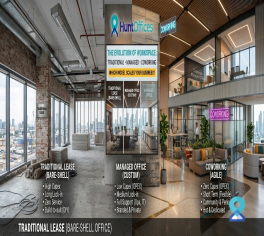
Managed Office vs Coworking vs Lease: Which to Pick?
Short answer
Read MoreCOWORKING SPACES
Coworking Space Agreement India: Lock-In, Deposit, Exit
Short answerA coworking space agreement in India is usually a license or service agreement, not a lease. Before you sign, check five...
Read MoreCOWORKING SPACES
Can You Claim GST Input Credit on Coworking Rent 2026?
Short answerYes. A GST-registered business can generally claim input tax credit (ITC) on the 18% GST charged on coworking fees, as i...
Read MoreCOWORKING SPACES
SP Infocity Udyog Vihar: Office Space & Coworking
IntroductionWhere you set up your office matters. It affects your team's commute, your clients' access, daily operations and even yo...
Read MoreCOWORKING SPACES
Sector 49 Gurgaon: Best Office Spaces in 2026
Quick Answer: Sector 49 Gurgaon is a mixed commercial and residential sector on Sohna Road, suited to startups, IT firms and corporate teams. The main o...
Read More